
Service
French doors London
Wooden French doors add a great deal to a London home – character, light, and a sense of considered craftsmanship that is difficult to replicate with other materials or opening styles. Whether you are restoring a period property sympathetically or specifying doors for a well- designed contemporary space, wooden French doors remain one of the most elegant and practical solutions available.
Timber door specialists Repair a Sash supply and install wooden French doors across London for homeowners who want something made properly, fitted with care, and finished to a standard that does justice to their property. From initial survey to final installation, the work is handled by joiners who understand London’s housing stock and the level of care it demands.
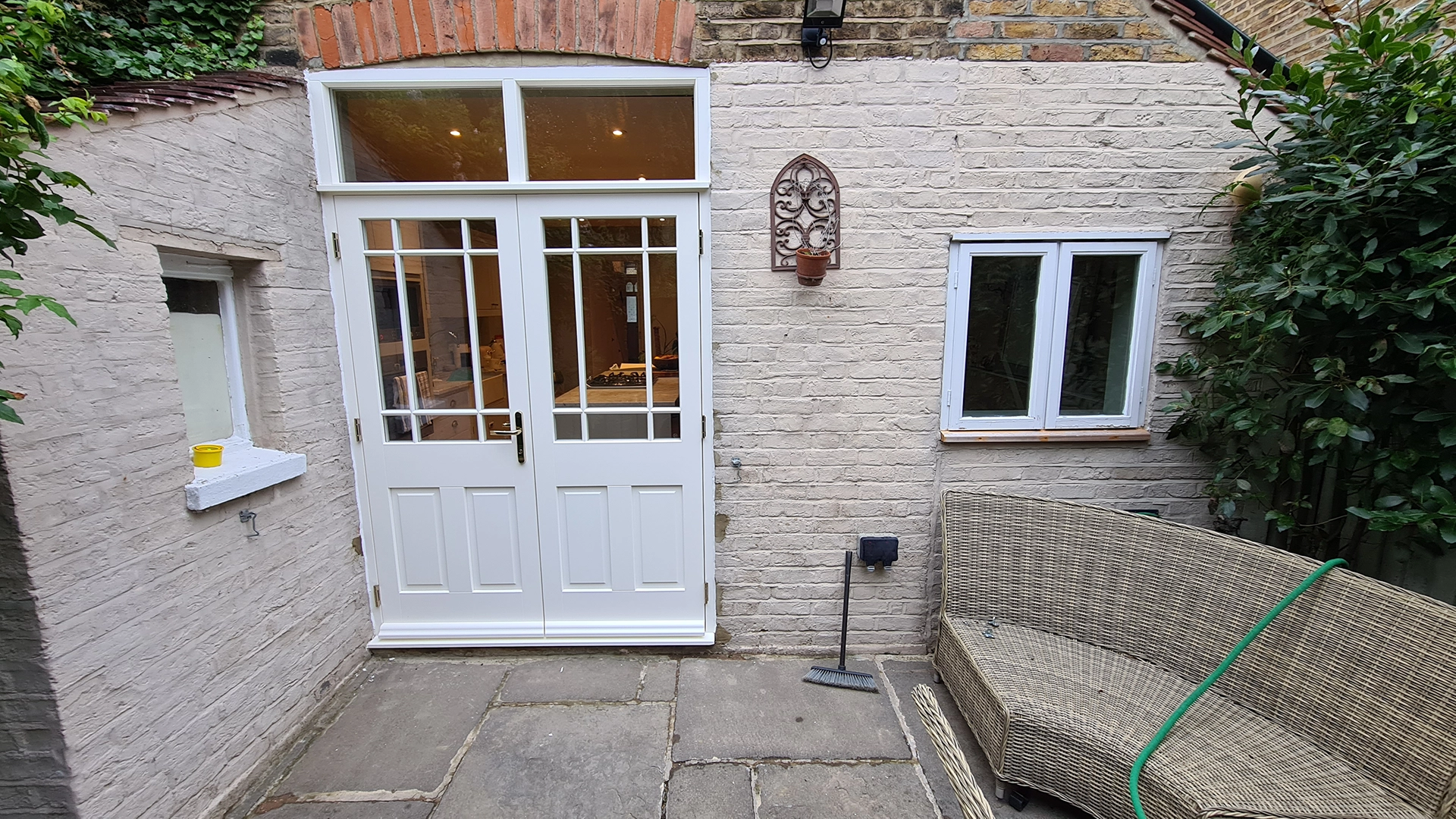
Wooden French doors for London homes
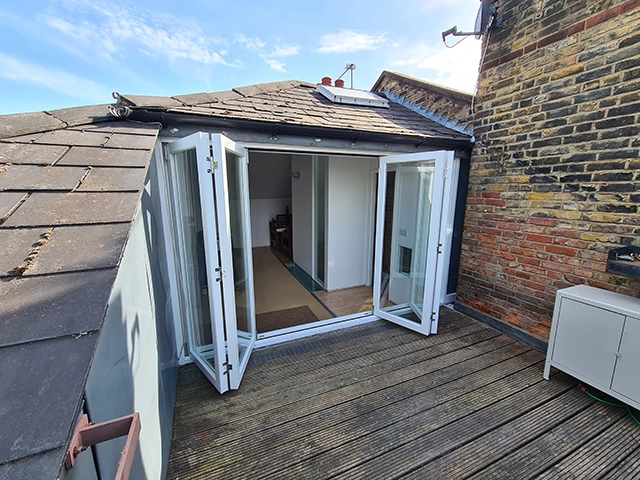
French doors are a two-leaf opening door solution – typically glazed, hinged on either side of a central opening, and designed to offer wide, unobstructed access between an interior room and an outside space. When both leaves are open, the result is a full, light-filled aperture that few other door types can match.
It is this quality that makes French doors particularly well suited to London’s period housing. Victorian, Edwardian, and Georgian properties were designed with rooms that relate to their gardens and rear spaces in a specific way, and French doors – with their glazing bars, symmetrical proportions, and traditional joinery details – fit that architectural logic naturally. In many cases, replacing a set of original French doors on a period property is not simply an upgrade: it is a restoration.
Timber is the right material for this work. It can be machined to match original moulding profiles, painted to a specific colour, and detailed in a way that feels consistent with the rest of the property’s joinery. Where aluminium or uPVC might look out of place on a Victorian rear elevation, well-made wooden French doors sit exactly where they should.
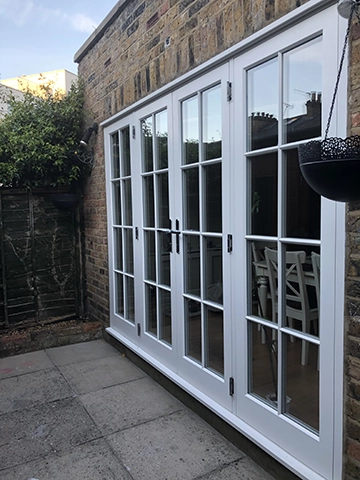
When French doors are the right choice
Not every situation calls for French doors, but there are settings where they remain the most appropriate and satisfying answer.
They work well where homeowners want a classic, symmetrical opening – two leaves swinging open in unison – rather than panels that slide or fold. They are an excellent choice where the priority is more natural light into a rear reception room, kitchen, or dining space, while also providing clean and direct access to a garden, terrace, or raised outdoor area.
French doors are also frequently the right answer for homeowners who want an alternative to bi-fold doors. Bi-folds perform well in certain contemporary contexts, but on a Victorian or Edwardian property, or in a setting where a more restrained and traditional aesthetic is appropriate, French doors tend to read more honestly. They are less industrial in proportion and more in keeping with the character of the building.
They also suit situations where the opening itself is not especially wide – where a bi fold’s multiple panels would be unnecessary – and where the symmetry of a two-leaf door adds something both to the room and to the elevation beyond it.
Not sure whether French doors, garden doors, or bi-fold doors are the better option?
The distinction between these three is sometimes confused, and it is worth being clear about what each one involves.
French doors have two opening leaves, hinged at either side of a central frame. Both leaves open to give a wide, unobstructed aperture. They are typically glazed and suit both period and well-designed contemporary properties.
Garden doors are a single-leaf solution – essentially one opening door within a frame, sometimes with a fixed light alongside. They suit narrower openings or situations where a single, straightforward door is the more practical answer.
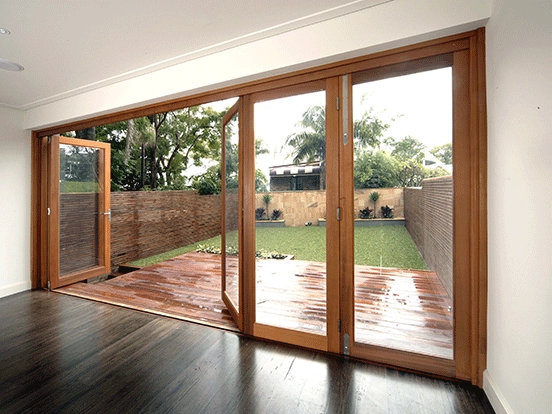
Wooden bifold doors fold back in sections on a track system, allowing the full width of a wide opening to be cleared. They tend to suit larger openings and more contemporary architectural settings.
If you are uncertain which is right for your property, we are happy to advise during a free survey.
Styles of wooden French doors
Timber French doors can be designed and detailed in a number of ways depending on the property and the homeowner’s preferences.
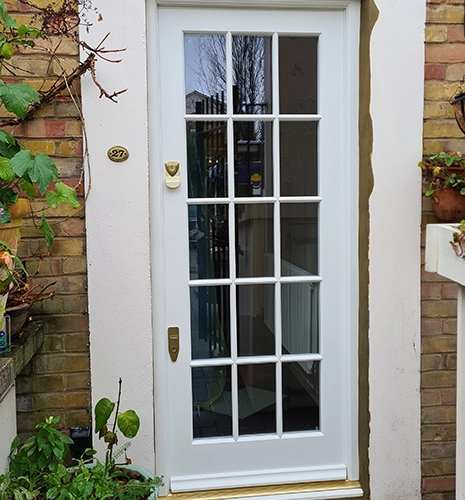
For period properties, the most common approach is a door that reflects the architectural language of the building: glazing bars, traditional moulded profiles, and a painted finish that sits comfortably alongside existing sash windows or casements. Georgian and Regency properties typically call for finer, more slender glazing bar sections; Victorian and Edwardian properties generally accommodate a slightly heavier, more robust detailing. In both cases, the aim is a door that looks as though it belongs.
For more contemporary properties or extensions, the detailing can be simplified: clean lines, minimal or absent glazing bars, and a paint or stained finish chosen to complement modern materials. Timber French doors in a contemporary setting have a warmth and quality that other materials do not always offer.
Where the opening suits it, we can incorporate side panels or fixed lights flanking the door leaves, increasing the glazed area and the amount of light entering the room without changing the door’s fundamental character.
Opening direction is a practical consideration. French doors can be hung to open inwards or outwards, depending on the threshold detail, the floor finish, and how the outside space will be used. We discuss this as part of the design and measuring process.
Our services
Renovation on time
and within your budget
Benefits of wooden French doors
More light and a better sense of space
A well-proportioned set of French doors brings a significant amount of light into a rear room, and when both leaves are open, the boundary between inside and outside effectively disappears. This is one of the main reasons homeowners in London specify them for rear reception rooms, kitchen-diners, and ground-floor spaces that lead onto gardens or terraces. The effect is genuinely transformative, particularly in properties where rear rooms have historically been darker.
A classic opening style with everyday practicality
Two leaves opening symmetrically is a satisfying and intuitive movement. French doors do not require tracks, folding mechanisms, or complex hardware – they open and close cleanly, and a single leaf can be opened independently when a full aperture is not needed. In practical terms, they are straightforward to live with and easy to maintain.
Security, insulation, and weather performance
Well-made timber French doors perform strongly on all three counts. Our doors are supplied with quality locking hardware as standard, and can be specified with multi-point locking systems where additional security is a priority. For thermal performance, double glazing, slimline doubleglazing, or vacuum glazing can be incorporated within a timber frame that itself offers good natural insulation. The doors are sealed and weathered to resist London’s variable climate, and can be specified for both inward and outward opening without compromising their weather performance.
Character, craftsmanship, and long-term value
Timber doors, properly made and well maintained, have a lifespan that outlasts most of the alternatives. They can be redecorated, repaired, and refinished over time without replacement. On a period property in particular, they add something that is genuinely difficult to value: a sense that the work was done properly, with materials and detailing that are consistent with the rest of the building. That quality tends to be noticed, and it tends to endure.
Materials, glazing, and finish choices
We manufacture our timber French doors in a range of carefully selected timbers, chosen for their stability, durability, and suitability for London’s conditions.
Accoya is a modified softwood that offers exceptional dimensional stability and a very long service life, performing well in exposed or high-maintenance positions.
Red Grandis is a sustainably sourced hardwood with a consistent grain and good stability, well suited to painted finishes.
Oak is a traditional choice for period and character properties, offering hardness, longevity, and a natural grain that reads well in both clear and painted finishes.
Engineered Redwood offers a reliable and cost-effective base for painted doors, with good stability and a straightforward manufacturing profile.
For larger or more demanding projects, we can manufacture doors in any timber of your choice, including where matching an existing species is required.
For glazing, we offer single glazing, double glazing, slimline double glazing, and vacuum glazing – the latter two being particularly relevant for period properties where narrow glazing bar profiles are important and thermal performance still needs to be addressed. The right glazing specification depends on the property, the existing joinery, and any planning or conservation considerations.
Finish options include painted, stained, or natural treatments. Where a specific colour or paint system is required to match existing joinery or meet conservation requirements, we can accommodate this. All ironmongery – handles, locks, hinges, and furniture – is selected to suit the style of the door and can be matched to the character of the property.
French doors for period, listed, and conservation properties
Many of London’s period properties sit within conservation areas, and a smaller number are listed buildings. Both designations can affect what is permissible when replacing or altering doors, and the requirements vary depending on the local authority, the specific property, and the nature of the work involved.
As a general principle, timber French doors can be manufactured in a way that is sensitive to heritage requirements – matching original proportions, glazing bar profiles, and moulding details, and using materials and finishes that are appropriate for the setting.
Our Notting Hill sash window restoration case study shows how a new timber French door was integrated into a former sash window opening as part of a wider listed-building joinery scheme.
Whether this satisfies the specific requirements of a listed building consent or conservation area appraisal depends on the individual circumstances, and we would always recommend clarifying this with your local planning authority before proceeding.
We are experienced in working on listed and conservation-area properties across London, and can advise on how best to specify doors in a way that respects both the architectural character of the building and any applicable requirements. Where applications or supporting information are needed, we can assist with the technical specification.
Our French door process
Free survey and advice
Every project begins with a free, no obligation survey at your property. We look at the opening, the surrounding joinery, the property type, and your priorities – and we offer honest advice on what will work best before any decisions are made.
Measuring and design guidance
Accurate measurement is fundamental to a well-fitting door, and we take this seriously. We also discuss opening direction, style, glazing, and finish during this stage, so that the specification is fully resolved before manufacture begins.
Timber, glazing, and finish selection
We guide you through the material and glazing options that suit your property and brief. Where there are heritage or planning considerations, we factor these in at this stage.
Manufacture
Doors are manufactured to your specific measurements and specification. We do not work from off-the-shelf sizes – every set of doors is made to fit the opening it is intended for.
Installation
Installation is carried out by our own team, not subcontracted. The work is done carefully, with attention to the threshold detail, the reveal, the ironmongery fitting, and the surrounding decoration.
Final checks and guarantee
Once installation is complete, we carry out final checks on operation, sealing, and hardware. Our work is guaranteed, and we are available to return should anything require adjustment after the doors have been in use.
FAQs about French doors in London
French doors are a two-leaf glazed door solution, with each leaf hinged at the outside of the
frame and opening inwards or outwards from the centre. When both leaves are open, they create
a wide, unobstructed aperture. They are most commonly used to connect interior rooms with
gardens, terraces, or raised outdoor spaces.
Yes – and in many cases they are the most appropriate choice. Period properties were typically
built with joinery proportions and details that translate directly into traditional French door
design. Timber can be machined to match original profiles, and a well-made wooden French
door sits comfortably alongside original sash windows and other period joinery in a way that
other materials often do not.
Patio doors typically slide rather than swing – one fixed panel and one sliding panel. French
doors both open outward or inward on hinges. The choice between them is partly practical and
partly aesthetic: French doors tend to suit period and character properties more naturally, while
sliding patio doors are more commonly found in mid-century and contemporary settings.
Garden doors, in our range, are generally a single-leaf solution – one opening door within a
frame. French doors always have two opening leaves. Garden doors suit narrower openings or
situations where only one leaf is needed. If you are unsure which applies to your opening, we can
advise during a survey.
Yes, in some cases. French doors can be a suitable option for balconies or Juliet balcony-style
openings where the proportions, guarding, and opening arrangement are appropriate. The right
solution will depend on the property, the available space, and how the opening is intended to be
used.
Both are possible, and we discuss opening direction as part of the design process. Inward
opening is often preferred where the external threshold is not level, or where furniture or planting
sits close to the outside of the doors. Outward opening is common where internal floor space is a
priority and the outside allows for it. Both can be specified with good weatherproofing.
Yes. We offer double glazing, slimline double glazing, and vacuum glazing, all of which can be
incorporated within a timber French door. Slimline double glazing and vacuum glazing are
particularly useful for period properties where retaining narrow glazing bar proportions matters
aesthetically or where conservation considerations apply.
Yes, when correctly specified and fitted. We supply our doors with quality multipoint locking
hardware as standard, and can advise on additional security measures where needed. Timber, as a
material, is inherently strong when well-made, and a properly fitted set of French doors performs
well for security.
Whether planning permission or listed building consent is required depends on the property, the
local authority, and the nature of the work. Listed buildings and properties in conservation areas
are more likely to require a more careful approach. We would always recommend checking with
your local planning authority before proceeding, and we can assist with the technical
specification where needed.
The cost depends on the size of the opening, the timber specified, the glazing option, the finish,
and the complexity of the installation. Because every set of doors is made to measure, pricing is
always tailored to the specific project. The best starting point is a free survey, after which we can
provide a clear and accurate quotation.
Why homeowners in London choose Repair a Sash
There is a version of this work that is done quickly and another that is done properly. Most of the London homeowners who come to us have some experience of the difference.
We work primarily on period and character properties – the kind of housing stock where the details matter, where a door that is slightly wrong in its proportions or its profiles is noticeable, and where the standard of the installation reflects on everything around it. That specialism shapes how we work at every stage: in the care we take with measuring, in how we specify materials and glazing, in the way we discuss options honestly with each client rather than defaulting to a standard answer.
Our installation team works to the same standard as our manufacture, and we do not use subcontractors for the fitting. After installation, we carry out final checks and stand behind the work with a guarantee. We have built our reputation in London on doing this kind of joinery properly the first time, and we take that seriously.
Book your free survey
If you are considering timber French doors for your London property – whether you are in the early stages of thinking it through or ready to move forward – the most useful first step is a free survey at your home.
We will look at the opening, discuss what will work best for the property and your brief, and provide a clear quotation with no obligation attached. There is no pressure and no hard sell: just practical advice from people who know this work well.
Get in touch to arrange your free survey, or to ask any questions before you decide.